I help founders turn messy ideas into products users actually understand.
Projects I'm truly proud of.
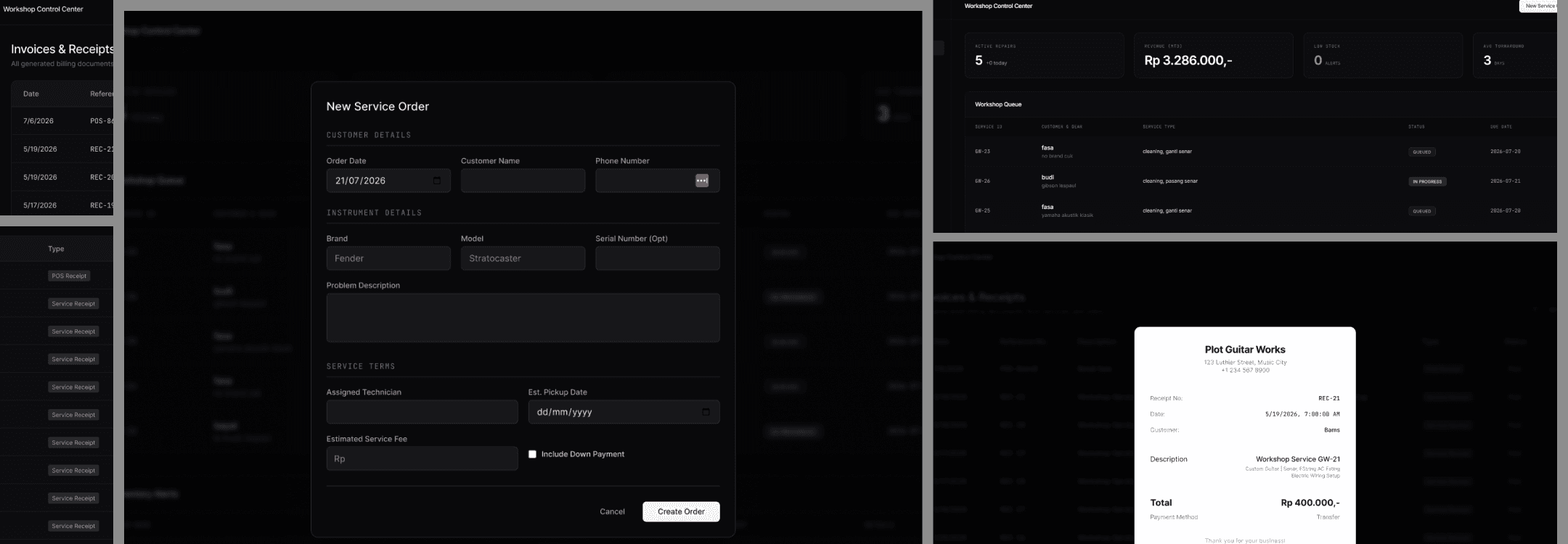
Mini ERP for Independent Guitar Workshops
Project Overview
Many independent guitar workshops still manage their business using notebooks, spreadsheets, and WhatsApp chats.
While enterprise POS systems exist, most are designed for retail businesses and come with monthly subscription costs that feel unnecessary for a one or two-person workshop.
This project explores how a lightweight ERP could help small workshops manage their daily operations while keeping costs close to zero.
The Challenge
Small workshops usually don't need a complex ERP.
They simply need one place to manage:
Repair Jobs
Spare Parts Inventory
Customers
Sales
Invoices
Payments
Most existing POS software includes hundreds of features they never use, yet still requires monthly subscriptions.
Tools:
Figma • AI • React • Supabase
Role:
Product Designer
Team:
Solo Project
Platform:
Web App
Timeline:
2 Weeks
The challenge became:
How might we build a simple workshop management system that solves the essentials without adding unnecessary complexity or recurring costs?
Goals
Instead of replacing enterprise software, this project focused on building something intentionally small.
The goals were:
Reduce manual bookkeeping
Track spare part inventory
Create invoices quickly
Monitor repair progress
Keep customer history in one place
Be simple enough to learn in minutes

Understanding the Workflow
Before designing screens, I mapped how a typical repair shop operates.

Before designing screens, I mOnce the workflow became clear, designing the interface became much easier because every screen supported a real task.apped how a typical repair shop operates.
AI-assisted Design Process
Rather than starting from a blank canvas, I used AI as a thinking partner throughout the project.
AI helped me:
brainstorm possible workflows
validate edge cases
generate database structures
organize ERP modules
speed up repetitive UI exploration
The final product decisions, interaction flows, and interface design were still curated and refined manually.

Design Principles
I kept returning to three simple principles throughout the project.AI helped me

KEEP IT SIMPLE
No unnecessary enterprise features.

REDUCE CLICKS
Common actions should take only a few steps.

SHOW WHAT’S IMPORTANT
Repair status, payments, and inventory should always be visible at a glance

Solution
The final MVP includes six core modules.
Inventory
Manage spare parts and stock levels.
Repair Jobs
Track repair progress from intake to completion.
Customers
Store customer information and repair history.
Sales & Invoices
Generate invoices directly from completed repairs.
Finance
Monitor incoming payments and basic cash flow.
Dashboard
A quick overview of ongoing repairs, low-stock alerts, and recent activity

Reflection
Building an ERP isn't about adding more features.
It's about understanding how people actually work.
Especially for independent Guitar Workshop Owner. The goal was to make the software approachable even for workshop owners who rarely use business tools.
By simplifying workflows instead of expanding them, the product becomes easier to adopt especially for small businesses where every extra click matters.
